
Deal With It

The CFS Advisory Committee will hold its next meeting on June 13-14th. This is the text of the public comment I offered at the previous meeting on October 25, 2011.


I ask the voting members of this committee: do you think this committee is effective? I believe that all of you serve with the best interests of CFS patients in mind, but let’s examine the track record – or lack thereof – for your own recommendations to the Secretary:

  • Regional centers for research and clinical care? No.
  • Healthcare provider education and training? No.
  • Use of the name ME/CFS across all agencies? No.
  • Research funding commensurate with the burden of this illness? No.
  • National effort to arrive at a new consensus case definition? No.

No no no no no.  No meaningful action.  No meaningful funding.  All your work, and what is there to show for it? You should be angry, or at least frustrated.

Five years ago, you recommended that NIH issue a new Request for Applications on CFS.  It didn’t happen.  Many patients expected new funding to be made available after the April State of the Knowledge meeting at NIH.  It hasn’t happened.  You know there is an urgent need right now for research funding, and we need you to hold HHS accountable.

Today, I urge you to recommend that NIH issue an RFA for CFS research backed by at least $10 million in funding, and that this RFA be issued in the next six months.  This recommendation is specific, actionable and measurable.  Furthermore, this money must be spent on CFS, not related conditions, and no more money should go to CBT or other psychological approaches.  We have begged NIH to fund research into pathophysiology,  objective diagnostics, and treatment; we have begged you to help us.  I agree with Bob Miller that for NIH to spend $600,000 on Dr. Fred Friedberg’s “commercially viable program of illness self-management” is an insult to every CFS patient.

At the State of the Knowledge meeting, Dr. Collins said that Secretary Sibelius had directed NIH and other agencies to give CFS “special attention.” Today we learned about a new HHS working group on CFS.  But talking is not doing.  I say we test this alleged commitment to CFS.  Make the recommendation that NIH issue a $10 million RFA for CFS research in the next six months.  At the next meeting of this committee, we can see if “special attention” actually translates into meaningful action.

I do not accept woe-is-me budget talk from federal officials, and neither should you.  We know that money can be found for high priorities.  Dr. Fauci’s appropriation of $2 million for the Lipkin XMRV study proves that.  Money is available, but the agency leaders are making conscious choices to spend the money elsewhere, on illnesses that are a “higher” priority.  NIH’s FY2012 budget request is for $32 billion.  Can anyone seriously believe that there is no money in that budget to increase research on CFS? Do you believe that this massive budget cannot be squeezed to find a few extra million for CFS research? The current level of NIH funding for CFS research is the equivalent of pocket lint.  Do not dare to tell us that there is no money for CFS research.  The money is there.  It’s just that NIH does not think we are worthy of it.

While DHHS fiddles, our lives are burning.  Physician education? We do that every time we go to the doctor.  Consensus case definition? Researchers and clinicians – not NIH or CDC – have participated in devising case definitions based on true evidence.  CFS research? We fund that ourselves.  Non-profits are funding pilot research that only then can secure government funding.

We are doing all this work ourselves, in cooperation with researchers and clinicians. Voting members, help us by pushing harder, by demanding meaningful, measurable action.  Pass a recommendation today that NIH issue a $10 million RFA for CFS research in the next six months.

All these years, we have done this work, and we will continue to do this work.  But I say to all of you: you are not off the hook.  As long as we have to deal with CFS, you have to deal with us.  We are still here.  Deal with it.
Posted in Advocacy | Tagged , , , , , , , , , | Comments Off on Deal With It

Significance of AT

Now that my exercise tests are finished and I have the results, it’s time to figure out what to do about it. I’m relying on the work of Staci Stevens, Chris Snell and others at the Pacific Fatigue Lab who have done a great deal of work on CFS metabolic dysfunction and how to cope with it. Everything revolves around my heart rate at the anaerobic threshold.

The anaerobic threshold (AT) is the point at which most energy is derived through anaerobic processes (as opposed to using oxygen) and lactate begins to accumulate in the bloodstream. As people cross their ATs, they are not able to sustain activity for much longer and experience the rapid onset of fatigue. People with CFS seem to have lower than normal ATs due to metabolic dysfunction, although no one can yet pinpoint where the dysfunction is. While a healthy person can get through work and other activities of daily living without reaching the AT, people with CFS can reach it just by taking a shower. As a result, we experience fatigue much earlier than healthy people and we continue to build up that oxygen debt as we eat, sit, walk up stairs, and so on. Any activity has the potential to cross the AT, building up yet more need for rest. It’s no surprise that we end up prostrate in bed, unable to do anything at all.

Rest and oxygen are necessary for recovery after crossing the AT, but people with CFS do not recover normally. Here’s an example that Staci Stevens gave in an article I wrote in 2010:

An athlete can climb two flights of stairs without fatigue or shortness of breath. A sedentary overweight person might climb the same two flights of stairs and feel out of breath, but will recover completely after a brief rest. A person with CFS may struggle to climb the stairs, and experience severe fatigue and PEM. In other words, the CFS patient reaches the AT after much less exertion than a healthy person, and requires a longer period of time to recover.

People with CFS end up in trouble from two directions. On the one hand, we cross our ATs abnormally early. And on the other hand, it takes us abnormally long to recover. It’s a vicious cycle, and I suspect that many of us spend large chunks of time over our ATs. I saw that in my own test results. One day two, I crossed my AT before I started biking and then biked for 11.5 minutes – all over the AT!!!

Common sense says that if something is bad for you, don’t do it. So the first step is to avoid crossing the AT. Obviously, we can’t spend our days hooked up to EKG and ventilation equipment to carefully monitor our ATs. But we can use heart rate as a proxy for the AT. My heart rate at the anaerobic threshold on day one was 105 beats per minute, and 93 beats per minute on day two. I am now wearing a heart rate monitor (this one) with the alarm set to go off when my heart rate goes over 95 beats per minute.

When the alarm sounds, I am supposed to sit down and rest until my heart rate drops back down. I’m also keeping notes on my activities so I can begin to pinpoint my true limits. If I can avoid my AT, I should be able to avoid taxing my body and triggering post-exertional malaise. Heart rate is not the perfect proxy. For example, my heart rate as I write this blog post is 79 beats per minute, and I will still be fatigued afterwards. But heart rate can at least help get my physical activity more in line with my capacity.

It’s been very surprising to see what activities push my heart rate over 95 beats per minute. Here’s a sample:

  • Walking from the back of my yard up an incline to the house
  • Rolling an empty trashcan up the driveway
  • Pulling weeds for two minutes
  • Walking up stairs at my normal pace
  • Standing at the reception desk at a doctor’s office
  • Laughing really hard (I’m giving my self a break on that one)

The first goal is to get my activity under control. Sometimes I won’t have a choice about going over the AT, like when I go to the doctor this week. But there are a lot of things I would normally be trying to do – weeding, laundry, going to our small farmer’s market – that I am not doing because it sets off the heart rate monitor. It will take some time to see if this really does help minimize my crashes.

Posted in Occupying | Tagged , , , , , , , , | 3 Comments

And the Envelope, Please

My exercise test results are in. The numbers were, quite frankly, shocking. Two numbers – VO2max and anaerobic threshold – provide the evidence that I have significant metabolic dysfunction, and I’ll try to explain what they mean. Check out my description of the test itself for background. What I do now that I have the results will be the subject of my next post.

VO2max is a measurement of the maximum amount of oxygen that a person can use during exercise. The more oxygen you can use, the more energy you can produce. VO2 max is considered the best measurement of a person’s physical fitness or functional capacity, and it is affected by factors such as age, gender, training, altitude, etc. A sedentary woman my age has an average of 27.0. My VO2max was 20.7 on day one, and 19.6 on day two. In other words, my maximum ability to use oxygen is 23% lower than what would be expected for a sedentary woman my age.

One interesting thing about my VO2max number is that I was able to reproduce the result on day two. Typically, people can reproduce their VO2max value on a two-day test with about 6-7% of variation. My number was about 5% different. So this is a good thing, but not necessarily typical of CFS patients. One study found that CFS patients had a drop of 20% in their VO2max on the second test day.

Dr. Betsy Keller of Ithaca College, who conducted my exercise test, included functional equivalents in her report to help translate the numbers into information I could actually understand. Looking at just the VO2max number, my capacity equates to slow cycling, but carrying groceries upstairs exceeds my functional capacity. That’s pretty grim.

Anaerobic threshold is where things get really interesting. The anaerobic threshold is the point at which your body is producing most energy through anaerobic metabolism, as opposed to aerobic metabolism which uses oxygen. This means that you will feel increasing fatigue, your workload will drop, and you will have to stop activity within a few minutes. It also takes longer to recover from this kind of activity, requiring rest and more oxygen. (Is this sounding familiar to anyone?)

On day one, my anaerobic threshold occurred at 105 beats per minute. That is not horrible, although it is low. A deconditioned but otherwise healthy person might have a result like that. On day two, however, my anaerobic threshold dropped to 93 beats per minute. That is abnormal, not just because it is low but because it represents such a significant drop from day one. Healthy people, even deconditioned people, are able to reproduce their anaerobic threshold results on day two. That I failed to do so is proof of metabolic dysfunction.

When you put the VO2max result together with the anaerobic threshold result, you can see the metabolic dysfunction another way. Normally, the anaerobic threshold will occur at about 50-75% of a person’s VO2max. But for me, my anaerobic threshold on day one occurred at 30% of VO2max. Anything below 40% is considered an abnormal result and evidence of metabolic dysfunction. On day two, my anaerobic threshold occurred at 17% of VO2max. That is crazy low. In fact, I reached that anaerobic threshold just sitting on the bike before I started pedaling on day two. Just sitting there, I was already maxed out. These are grossly abnormal results.

To equate these numbers to functionality, Dr. Keller said that my day one anaerobic threshold is the equivalent of standing to fold laundry, or putting clothes in the washer, but that walking around to put away laundry would be beyond my capacity. But on day two? The day two result is the equivalent of lying down watching television. So when I am in a crash, I am exceeding my anaerobic threshold by just lying down and watching tv or doing nothing.

So no wonder I feel like shit all the time, yeah?

There were other abnormalities, including blunted heart rate and blood pressure responses, but these two numbers are the key for me. As Dr. Keller points out, most activities of daily living require me to work above my anaerobic threshold. This means my ability to perform those activities is limited, and resulting fatigue prevents me from continuing to perform those activities.

Here’s the killer fact for me, though. On day two, I was at my anaerobic threshold before I even started cycling. Then I proceeded to cycle for 11.5 minutes, and came close to the length and workload I produced on day one. The whole second day was past my anaerobic threshold. I felt and rated day two as more difficult, but I kept going anyway. I draw two conclusions from this. First, I have become accustomed to operating over my anaerobic threshold and have probably developed that as an adaptive coping mechanism. Second, I cannot trust my my own assessment of when I am overdoing it. My sense of how I am feeling is not reliable.

My husband’s reaction to that was “Duh.” It will surprise no one who knows me that the test proves I am a stubborn and determined woman who does not accept her own limitations. But it was a shock to see this reduced to numbers and written in black and white on the page.

A friend pointed out to me that nothing has actually changed. It’s not like I’ve suddenly developed a heart condition. The only thing that has changed is the information I have about the metabolic dysfunction. Knowledge is power, and next time I’ll share what steps I’m taking to apply this knowledge.

Posted in Occupying | Tagged , , , , , , | 13 Comments

Be Aware

Today is ME/CFS Awareness Day. Why May 12th? It is the birthday of Florence Nightingale, who became bedridden with an illness resembling ME/CFS after the Crimean War. From 1860 to her death in 1910, Nightingale continued to work for the causes she believed in despite her illness and disability.

ME/CFS Awareness Day began 20 years ago, spearheaded by Tom Hennessy of RESCIND. Today, you will see blue ribbons on Facebook and Twitter avatars, and patients are making efforts to get this day into the public eye. The spring meeting of the CFSAC usually coincides with Awareness Day, making it possible for patients to combine meeting attendance with visits to Congress but that did not happen this year. But for the first time I am aware of, the CFSAC is marking the occasion with a statement from Dr. Nancy Lee.

I have a few ideas for how we can mark this day.

  • If you are a CFS patient, be aware that you are not alone. Take a moment to connect in some way, even just in your thoughts, to the world community of people with ME/CFS.
  • If you know a CFS patient, be aware that our illness and suffering is invisible to most people. Take a moment to reach out and tell him/her that you care.
  • No matter who you are, be aware that not enough people are aware. Take a moment to tell someone, ANYONE, about CFS and the devastation it causes.

Great resources that tell the story of CFS:

A Sudden Illness by Laura Hillenbrand – quite simply the best article about having CFS that I have ever read

The Long, Tangled Tale of CFS by David Tuller

The Puzzle of Chronic Fatigue Syndrome by Amy Dockser-Marcus


Posted in Advocacy, Commentary | Tagged , , , , | Comments Off on Be Aware

Small Claims

In April, the FDA sent a warning letter to Dr. Jacob Teitelbaum regarding claims made on his website. Dr. Teitelbaum is well-known in the CFS world for several reasons. His book, From Fatigued to Fantastic, is the top-selling book in Amazon’s category for CFS. Dr. Teitelbaum is medical director of the Fibromyalgia & Fatigue Centers, a chain of clinics that offers a six step treatment process for fibromyalgia and other illnesses. Finally, Dr. Teitelbaum is a frequent contributor to the Dr. Oz program, where he is described as overcoming CFS and fibromyalgia in 1975 and “has helped hundreds of thousands recover from these conditions.”

In its warning letter to Dr. Teitelbaum, the FDA cited multiple violations of federal law on the website where supplements were characterized as treatments for a variety of illnesses including breast cancer, heart disease, and arthritis. None of the cited violations related to CFS, but the FDA stated, “The unlawful disease treatment and prevention claims made on your website were too numerous to list in this letter.”

Under federal law, a product is a drug if it is “intended for use in the diagnosis, cure, mitigation, treatment, or prevention of disease.” 21 U.S.C. § 321(g)(1)(B). Drugs are regulated by the FDA, and cannot be marketed without prior approval by the FDA after submission of data demonstrating the drug is safe and effective. By claiming his products could treat or cure disease, Dr. Teitelbaum was claiming those products were drugs. Since he was selling those products without FDA approval, Dr. Teitelbaum was violating federal law.

Dietary supplements, in contrast, are regulated very differently from drugs. Supplements do not need to be proven safe and effective prior to marketing. A manufacturer can claim that a supplement addresses a nutrient deficiency or is linked to a body function (such as immunity) if there is research to support such a claim, but must explicitly state that the FDA has not evaluated the claim.

According to the Natural Products Insider, there is a “fine line between educational  information on non-drug products and claims made in promotion of products for sale.” Physicians (or others) who offer information on the benefits of natural therapies cannot link that information to specific products that they sell. Natural Products Insider recommends keeping the treatment and research information “third party” and keeping product claims within legal bounds.

To me, this is a distinction without a difference. Under current law, it is illegal to market Product XYZ as a treatment for CFS but it is perfectly acceptable to market Product XYZ as a way to boost energy. The average consumer can read the second claim, and draw a short straight line back to CFS. It is relatively easy to write marketing copy in such a way that consumers fill in the blanks themselves, believing that a product is a treatment for CFS without the vendor ever having made that claim. In Dr. Teitelbaum’s case, the problem was not that he is selling “Eskimo 3 Fish Oil.” The problem is that he was selling “Eskimo 3 Fish Oil” while claiming it “can help treat hidden depression” (among other things). Change the language and go right back to selling to your heart’s content.

I know many CFS patients who take a wide range of supplements, and a number of them do detailed research on products before they buy. I know doctors who recommend a variety of natural and alternative remedies. I’ve experimented with many supplements and remedies myself. But it is important to remember that regulation of these products is very different from that of conventional treatments. I’ve seen ads for products that are barely different from the material that got Dr. Teitelbaum in trouble with the FDA. There is not a single treatment for CFS that has been approved by the FDA. CFS patients want to be well, or at least a little better if we can. Tell me a product will help my immune system, and I’ll wonder if it can help my CFS. You don’t have to stamp the word “treatment” on it for me to wonder if it is just that. Marketing through implication is ok under current federal law, but I don’t think this translates into extensive consumer protection in practice.

Posted in Commentary | Tagged , , , , , , | 3 Comments

Recoverin’

Three weeks ago, I had my exercise stress tests. A friend had cautioned me that it could take three weeks to recover, and I think she was right although I did sabotage myself a little bit, as I’ll explain.

I was not prepared for how bad the post-test crash would be. I mean, I knew it would be bad but this was possibly the most intense crash I have ever had. I was completely bedridden for three days, and was unable to sit up longer than the time it took to eat (in bed). The pain was excruciating, especially in my legs. My brain was fuzzy, and I could not focus on anything. But it was the weakness that really shocked me. I felt like a Raggedy Ann doll, my limbs all floppy. When I stood, I felt like I should sit right back down. My arms tingled with that weird pins-and-needles feeling I get before I pass out, although I did not faint. I could not hold my head up for very long without support. To get to the bathroom, I had to resort to my old castigation mind-trick: “You are not paralyzed. There is nothing wrong with your muscles. You can’t wet the bed like an invalid. Get off your a** and walk to the bathroom.” (It occurs to me that I would never speak to a sick person this way, but that self-reflection probably merits its own post.)

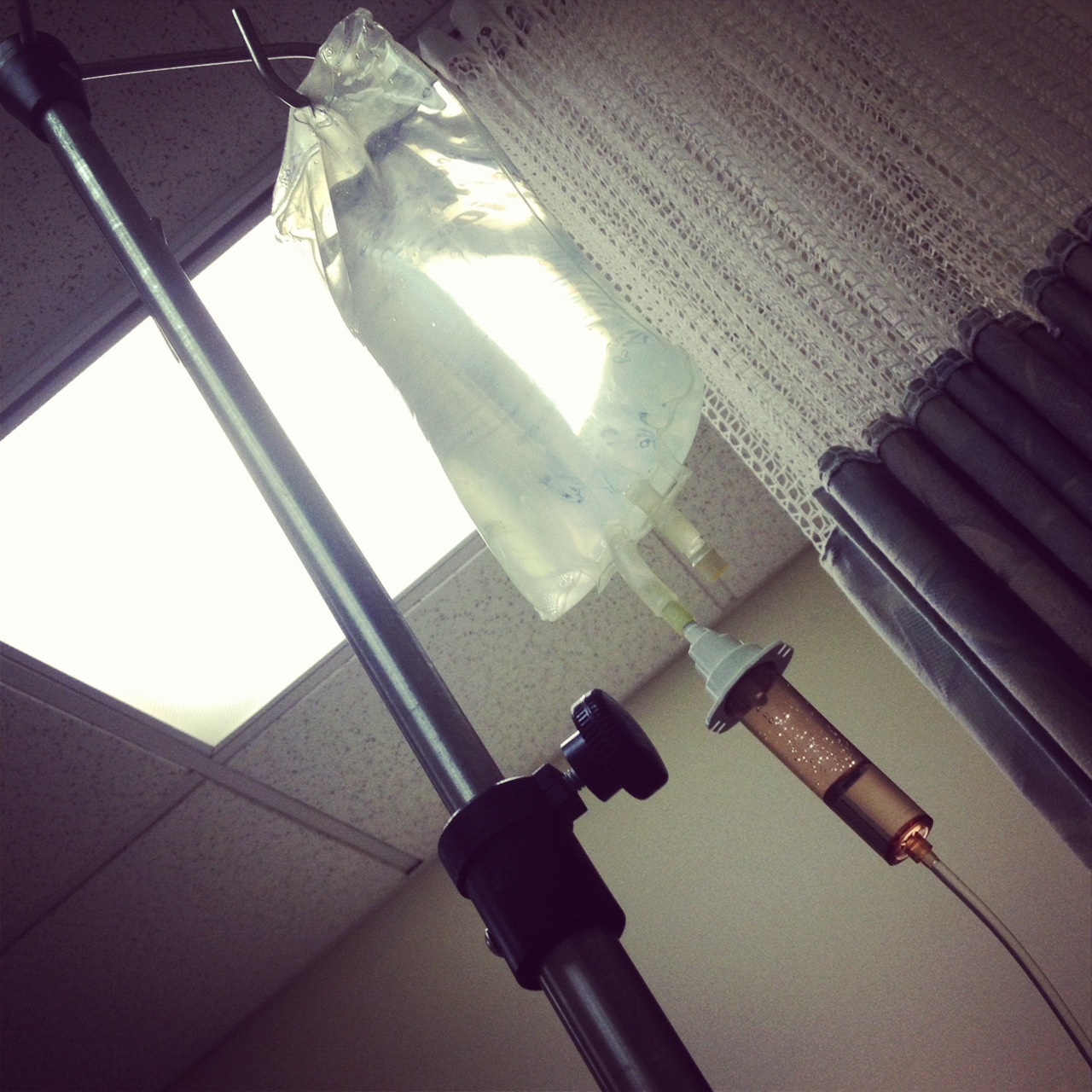
I’ve had a day or two of crashing as severe as this many times over the last 17 years. But this crash went on for days. I’ve never gone as long as a week with that floppy spaghetti-noodle weakness in my limbs. I started to get a little scared. What if the exercise test broke something in me? What if this never got better? Both my friend and Dr. Betsy Keller had said that some patients benefited from IV fluids after the exercise tests. I’ve never tried it before now, but after five days I was feeling desperate to try anything to break the pattern. My doctor agreed, and I went to his office for the infusion. Another first: I have never used a wheelchair to get to his office before. He even ran the line himself, and I received 2 liters of IV saline over the course of three to four hours. After the nurse hooked up the second bag and increased the drip rate, my head started to clear a little bit. Then the floppy feeling started to dissipate. By the time my Mom brought me home, I did feel a little better, despite the energy expenditure of going to the office.

I felt like I turned a corner after that. I still could not be out of bed for very long. Standing at the sink for five minutes was too much. Getting up to put away a couple books brought on the now-familiar weakness. But I could sit up in bed and read, focus on a movie, or knit for awhile. That was a huge improvement. Then came the Hot Water Heater Episode, and I had a setback. I was back to being bedridden for a couple days, unable to stay upright without support. But by the end of week two, I did experience a little improvement. The pain in my legs was back down to pre-test levels. I no longer felt like I might pass out. And I started to feel a little bored, always a good sign for me. There is no doubt I was still crashed, but I started to think I might actually climb out of this one.

Then I sabotaged myself, a little. Long before my exercise test was scheduled, my parents had purchased handicapped-accessible tickets for my husband and I to accompany them to a baseball game. I still wanted to go. In fact, when my husband and I discussed whether I was physically able to go, I told him I couldn’t handle the emotional consequences of not going to the game. I was scared, unsure what the outing would do to my recovery and how bad the setback might be. But I threw caution to the wind and went anyway. I am so very glad I did! We had a blast, and it is always such a gift to get out in the world after a prolonged relapse. I’m sure that it has added days to my recovery. I’ve spent these last few days “resting aggressively.” Tomorrow is our 16th wedding anniversary, and I don’t know if I will be able to go out to dinner to celebrate.

My understanding is that a recovery time of more than one day after exercise testing is considered abnormal. In one study, none of the CFS patients recovered within 48 hours and 60% of CFS patients took more than 5 days to recover. That particular study only followed patients for 7 days post-testing, so it is likely that many of those patients took more than a week to recover. I think three weeks was a reasonable estimate for me. If I hadn’t indulged in the baseball game, I might be pretty close to baseline by now.

Instead, it’s three weeks out and I am writing this from bed. As soon as I publish this post, I will lie back down as I feel my head getting heavier – the concrete football helmet of fatigue. I won’t attempt anything more demanding than knitting for the rest of the day, and have some audiobooks to fill the time. Whether we go out to celebrate our anniversary will be a last minute decision, and I have already mentally allocated next week to more bed rest. I hope I can be back at baseline by the end of the week, but as anyone with CFS knows, I am ultimately not in control of whether I make that deadline.

Posted in Occupying | Tagged , , , , , , , , , , , , , , , , , | 6 Comments

While We Wait

Still waiting for exercise test results.

Still waiting for recovery from exercise tests.

Still waiting for the brain power to research and write some in depth blog posts I’ve been planning.

But life doesn’t give us many breaks, so cue complaint!

At 7am Sunday morning, we discovered that our hot water heater was leaking. A lot. Apparently, it sprung a leak overnight and proceeded to discharge gallons of hot water onto the basement floor. I won’t even go into the Basement Saga we have endured for the last 18 months or so, but suffice to say that this was not the first time my husband has cleaned up water from the basement floor. And that’s how he proceeded to spend his Sunday: cleaning up the spill, emptying the water heater out, discarding waterlogged stuff. We couldn’t get a new water heater installed until mid-day Monday, so we went about 36 hours without hot water.

If you have CFS, you know that stress is very very bad. I managed enough detachment to observe the cascade effect of this stress in my body. The adrenalin rush after we found the leak hit my gut first, with spasms and pain, and triggered orthostatic intolerance symptoms of dizziness and weakness. Nausea and fatigue came next, and then anxiety about how we would find a way to deal with this mess. Deep breathing and emotional support helped calm the anxiety, but fatigue and post-exertional malaise swept in. I was flat on my back and out of commission.

I had a criminal law professor who liked to say, “If you believe that, you’ll never own your own home.” Sometimes I wonder if people with CFS should not try to own their homes. It’s nice to have control over your space, until something breaks and you have to be in control of that too. This kind of day-to-day stress is just unmanageable for me when I am in a crash. I am not capable of mopping the basement floor or carrying wet trash up the stairs. When I’m sick like I am in the wake of the exercise tests, I’m not capable of dealing with a contractor to get a new water heater installed. I’m really not in any kind of shape to make a cup of tea, let alone deal with the perfectly normal problem of a busted water heater.

End complaint. Cue gratitude.

I am so fortunate to have a home, when many CFS patients do not. We can afford to have the water heater replaced. I have a husband who is able to clean up the mess and work from home to deal with the contractor. My mom was staying with us to help with cooking, errands, etc. and she found the leak Sunday morning, hours before my husband would have himself. She helped him with the clean up. Nothing valuable was damaged. And compared to the water situation in most of the world, 36 hours without hot water is really not a big deal.

This episode was an annoyance, in the grand scheme of things, and we dealt with it. No lasting harm was done. What is most upsetting to me about the whole thing is that I could not have coped with it alone. Even on a good day, I am too disabled to manage this kind of homeowner responsibility by myself. This incident throws a spotlight on the fact that I could not live by myself, not without a great deal of assistance. It’s not fair, and both pisses me off and makes me sad. And it fills me with compassion for those of you with CFS who DO live alone, and find ways to cope.

Posted in Occupying | Tagged , , , , , , | 4 Comments

Stressin’ and Testin’

Exercise testing for CFS is like professional boxing: you know you’ll get the crap beaten out of you, but you volunteer for it anyway. The difference is that in boxing, you get paid. In CFS exercise testing, you just hope to get some useful data. I don’t have the results of my testing yet, but I thought it might be helpful to at least share what the experience was like.

The rationale for exercise testing in CFS comes primarily from the research of the Pacific Fatigue Lab at the University of the Pacific. Their research has shown that people with CFS have a unique response to a two-day exercise challenge compared to healthy sedentary controls or people with other illnesses. In the second test, people with CFS demonstrate significant impairment of their metabolic function. In other words, the testing captures the effects of post-exertional malaise. If you want to read more about this, you can check out the series of articles I wrote on post-exertional malaise in 2010.

The Pacific Fatigue Lab testing calls for two cardiopulmonary exercise stress tests (CPET), spaced 24 hours apart (referred to as the Stevens Protocol). I went to Ithaca College to have my testing done by researcher Dr. Betsy Keller, who has provided the CPETs for CFS research by Dr. Maureen Hanson and Dr. David Bell. I was instructed to rest for several days in advance, and to eat frequent carb-rich snacks of fruits, whole grains, etc.

The test began with blood pressure and EKG measurements taken while I was lying down. Then we moved to the stationary bike. I was fitted with a nose clip and scuba-like mask so that my oxygen and carbon dioxide could be measured and analyzed. The EKG leads were hooked up to another machine so that my heart could be monitored throughout the test. Then I sat on the bike without pedaling for three minutes, so that resting data could be collected. My blood pressure was measured every two minutes throughout the test. I got the order to start pedaling, and every two minutes a little more resistance was added to the bike so I had to work harder as the test continued.

And it was hard. Very hard. The techs were constantly shouting encouragement, telling me how much time was left at each resistance level, goading me to push to the next level. Every two minutes, someone would ask me to rate my level of perceived exertion and that was recorded as well. There was so much going on, all I could do was focus on pedaling the bike. The goal of the test is to pedal until you feel you cannot go any further. Not I-would-like-to-stop-now, but I-will-fall-off-the-bike-if-I-have-to-keep-going.

Once I hit that point, they dropped the resistance from the bike and asked me to pedal a little more to start cooling down. I was just on autopilot at that point, barely paying attention to what was going on. They kept taking my blood pressure to be sure that it started dropping back down to normal. Finally, they helped me off the bike and into a chair to recover. The best part was then being helped into the next room to lie down!

On the next day, we did the whole thing over again. It was definitely more difficult the second day, although I don’t have any data yet to say whether they saw the dysfunction they expected. Once I cooled down from the second test, I was helped to the car and allowed to go home.

I think I will do a separate post about recovering from this test. Suffice to say, it sucks. I just hope the test data will be helpful.

Posted in Occupying | Tagged , , , , , , , , , | 5 Comments

Some Life in Me Yet


Being housebound changes a person. These four walls have become the boundaries of my whole world. I rely on books and the internet to remind me that there is more to life than this. My imagination can escape, even if my body cannot. But over time, it has become easier to forget about what lies outside. Instead of seeing these walls as part of what is, it has started to feel like the walls are what should be. That I am trapped, and always will be, and that this is all there is. I will sit still while the world goes on. I am not a part of it, anymore.

But who knows what she spoke to the darkness, alone, in the bitter watches of the night, when all her life seemed shrinking, and the walls of her bower closing in about her, a hutch to trammel some wild thing in? – Return of the King

But our trip to New Orleans took me outside this cage for a little while. I got out from under the burden of these walls.  And I realized – I remembered – that LIFE surrounds me. There is more out there than the same trees and bushes I see from my windows. Different sky, different people, different sounds. New music, new food.

It was like taking off sunglasses on a cloudless day, everything seemed so bright and fresh. Have you ever had the wind knocked out of you? This was like taking that first deep breath after gasping for air. It was emotionally and spiritually invigorating, despite being physically exhausting.

And I remembered something. My life is about more than enduring this confinement and searching for a way out. I care about more than the contents of my home, and the tired, dusty thoughts in my mind. My life is not an endless monotonous slog towards another day of more of the same. I can touch the world, not just read about it. I can feel it smell it taste it see it hear it. I am PART of it, just like anyone else. There is some life in me yet.


Posted in Commentary, Occupying | Tagged , , , , , | 5 Comments

Tips for a CFS Vacation

My husband and I were fortunate enough to take a vacation to New Orleans last month, and I am still recovering. But I did want to share what I learned (or re-learned) on this trip about traveling with CFS. I wish there was a magic pill that would allow us to take vacations from CFS, but in the meantime, here is some of what has helped me while traveling.

  1. GO! First of all, go on vacation if it is at all feasible for you. My husband and I manage vacations once every five years or so. We might travel for a family gathering or go a short distance in summer, but to actually get on a plane and go somewhere is a really big deal. The physical and financial costs are very high, but the emotional benefits are also high. I think it is critical for those of us who are disabled, especially housebound people like me, to get a change of scenery. There’s probably research showing how important it is cognitively and emotionally for housebound people to see and experience new things, but even if the research does not exist I believe this to be true. There is no substitute for getting a break from the daily grind, so if it is possible for you to get away then I highly recommend you do.
  2. Planning. I’ve always been a planner and list-maker. But traveling with CFS requires extreme planning. The biggest challenge I have on vacation is wanting to do more than I am physically able. My list of “essential” things to do in New Orleans would probably be a lot for even a healthy person to do. My husband finally asked me, “What are the things that if you do not do, you will feel the trip was a failure?” That changed my perspective towards the list, and helped me narrow it down. It was still too ambitious, but it did help me identify what my highest priorities were so that we could focus our energy.
  3. Hotel. Stay in the nicest place you can afford. I spend most vacation time in the hotel room, so we are willing to pay more than we would if I was healthy. A nice view, comfortable bed, and friendly staff take a little bit of the sting out of being stuck in a hotel room. I always hit a point on vacation where I feel like I could stay in my bedroom for free at home, so it’s a waste of money to travel. But see item #1 on this list. A different four walls and view out the window is a good thing. We have also found that staying in a hotel with room service is important, if we can swing it. On this trip, my husband spent several days in meetings. No room service would have meant I didn’t eat when I was unable to leave the hotel room. A hotel room with a kitchen would be an alternative. There was a nice market near our hotel, so we could stock up on fruit, cheese, and so on to help offset the exorbitant costs of room service.
  4. Devices. Even if you do not use a wheelchair or other assistive device on a day-to-day basis, consider using one on vacation. On some previous trips, we have rented a scooter for me and that was great. I have my own manual wheelchair now, so we travel with that. There is no substitute. Using a scooter or wheelchair enables me to be out of the hotel room much longer, and enjoy walking-intensive activities like museums. I’ve never used a rollator, but that might be a good thing to try for some people. There are other advantages to using a wheelchair, as well. For example, you go through a separate (much shorter) line at airport security. Destinations like Disneyworld are extremely wheelchair-friendly, with separate (much shorter) lines and very well-trained staff. New Orleans was not as great in some places, like the French Quarter where the sidewalks are old and bumpy. But for the National World War II Museum, it was the only way I could go.
  5. Airports. I hate to fly. I hate airports, the people, the noise, the sensory overload, sitting upright for long periods of time, struggling with baggage, etc. I hate it. So we do what we can to minimize the negatives. We fly direct if at all possible. We bring my own wheelchair (so we don’t have to rely on airline personnel to show up at the right time with a wheelchair) and we check it at the door of the airplane. We ask for help at security, the gate, baggage claim, and anywhere else we need it. That help may not always be forthcoming, but we always ask (and are sometimes pleasantly surprised). We make sure to bring adequate fluids and snacks on the plane. And my most indispensable piece of airplane endurance equipment is noise cancelling headphones. I don’t even always hook them up to my iPod. It makes a big difference in cutting the noise of the engines and the chatter of other passengers (that I can never seem to block out).
  6. Schedule. Build rest days into your schedule, and then build in some more. I never plan enough time for rest. This vacation was the longest we have ever taken – 10 days, and I had four days when I did not leave our hotel room at all. I am better about planning rest times during any given day, since I know that I can’t be out for more than a couple hours. I also tried to plan ahead. There were a many restaurants I wanted to try, and on two days I did nothing all day to be sure that I could go out to dinner that night. Flexibility is also key. We adjusted our plans based on lots of things, including how I was feeling, the impressive New Orleans thunderstorms, and how crowded we thought a location might be. For example, we wanted to see the parade of the Mardi Gras Indians, but had to let that go when we found there was no safe, wheelchair-friendly way to do it. Museums tend to be less crowded during the week. And we learned about weekend crowds in the French Quarter the hard way! I much prefer predictable, planned schedules, but we went into this trip knowing we would have to adjust on the fly and it helped.
  7. Nutrition. Ensuring I have adequate nutrition and hydration seems like such a basic skill, but it has taken me a long time to master.  We had the convenience of a nearby store and the hotel market (very handy for when I was by myself and really needed to boost my electrolytes). Carry food and fluids with you everywhere. Pack your vitamins and supplements. I was surprised that I needed better hydration than normal while traveling, which I guess is true for everyone. It’s much better to carry those supplies along with you and not need them, than deal with the reverse.
  8. Alone. Expect to spend some time alone. Your partner, family or friends will undoubtedly want to do things you cannot. In our case, my husband had business-related meetings to attend. If you plan ahead, it is a little easier to tell your family to stay at the pool while you rest, or send your partner off on a hike without you. In my case, this meant knitting. I had several audiobooks on my iPod, and I packed lots of yarn. For the first time ever, I knit all the yarn I brought along (can’t show you, as they are presents). I cut my security blanket and left the computer at home, compensating with the iPod and e-reader. It meant less weight to carry, and I had more than enough entertainment to fill the many hours in the hotel room.
  9. Buddy System. I am housebound and live in the suburbs. I am not able to drive, and this means that anywhere and everywhere I go at home is with someone. To be in a city, with cabs readily available, and neighborhoods to explore, I felt like I had reached an oasis after a week-long desert trek. And if I had done as much as I wanted, I would be as sick as the dehydrated person who over-drinks at the oasis. I’ve developed restraint out of self-preservation, but I still need someone to hold me back. My husband is frequently better attuned to my limits than I am, simply because I want to keep going. Relying on your companion(s) to help you gauge when it is time to rest or stop altogether can really help. I went out one day on my own and definitely overdid it. Maybe it’s just me, but having a friend be my reality check is important to avoiding early burnout.
  10. Disappointed. Despite all the planning and flexibility, I did not do all the “essentials” on my list. The reality of CFS is that we cannot do even a fraction of what we want to do. I’ve been sick for more than 17 years, and my desires have still not completely calibrated to my capacity. I had a lovely vacation, but I can’t help thinking that a few more days might have made it possible for me to manage those last few things on my wish list. Now that I am home, I am trying to navigate the waters of disappointment. But the root of it is that CFS insisted on accompanying me on vacation, and nothing can change that. Considering my degree of illness, and what my normal life is like, this vacation was a huge success. Realistic expectations help offset the inevitable disappointment of traveling with CFS.
Posted in Occupying | Tagged , , , , , , , | 9 Comments