
My dad saw me addressing holiday cards a few days after Thanksgiving. “You’re SO organized!” he said, half admiringly and half chidingly.
Law school accentuated my natural tendency to be organized, but ME made it more intense. “I HAVE to be this organized,” I told Dad. “The only way I can get anything done for the holidays is to pace myself, so I make a schedule and spread things out over as much time as possible. I have to.” I use the same series of steps to plan every year, although the results differ depending on how sick I am and what else is happening in life.
We’re in the home stretch, with Hanukkah starting last night and Christmas less than two weeks away, but my approach is more about mindset than activities. Whether you will light Hanukkah candles with friends on Zoom or open Christmas gifts with your family or mark the season another way, I hope you can find something helpful in how I do this.
Step One: Early Brain Dump. Thinking about the holidays can stress me out, especially when I don’t know what I don’t know. So in October, I start by making a list of every possible decision, event, and task, knowing full well that I can’t get it all done. I just need to get the big picture down on paper so that I can start making choices. Here are a few examples in each category.
- Decisions: when will we travel to visit my family; when will we gather with my husband’s family; our gift budget.
- Events: doctor appointments between mid-November and early January; my niece’s Christmas concert; family members’ travel schedules; deadline for ordering and/or mailing gifts in time for Christmas.
- Tasks: buy presents; send holiday cards; bake cookies.
Step Two: Reflect. In the past, I made the mistake of going from my brain dump straight into figuring out how to get it all done. That’s a surefire way to end up crashed and disappointed. So I’ve learned to stop and think about what matters most and how I want the holidays to feel. Spending time with family is always top priority, but it helps me to remember why. I missed my family so much during the pandemic lockdown. I will sacrifice a lot to make it possible to be with them in person over the holidays. Being clear on that makes it easier to let go of other expectations and stay in a positive, loving frame of mind.
Step Three: Assess. This is the critical step for people with ME. How am I doing physically? How much energy do I think I’ll have? There have been years where I was stuck in bed most of the time, and years where I could tackle something every day. Before I can make decisions about what I’m doing, I need to be clear on the resources I have available. I can’t attempt to make cookies if I’m so sick that showering is a struggle. In the hardest years, I had to save all my energy just to spend a few hours with my family on Christmas Day. Now that my immediate family lives in a different state, I have to account for the effort of travel (and recovering from it).
I am fortunate that I have always been able to spend at least some time with my family at the holidays. Many people with ME are not able to. Some are bedridden, some can’t travel to where their families are, and some can’t risk getting sick with COVID or flu. Some of us have supportive people in our lives who understand, and some do not. It is so hard to look at your limitations and admit that you can’t do something, especially during the holidays. Be kind to yourself as you make the tough decisions.
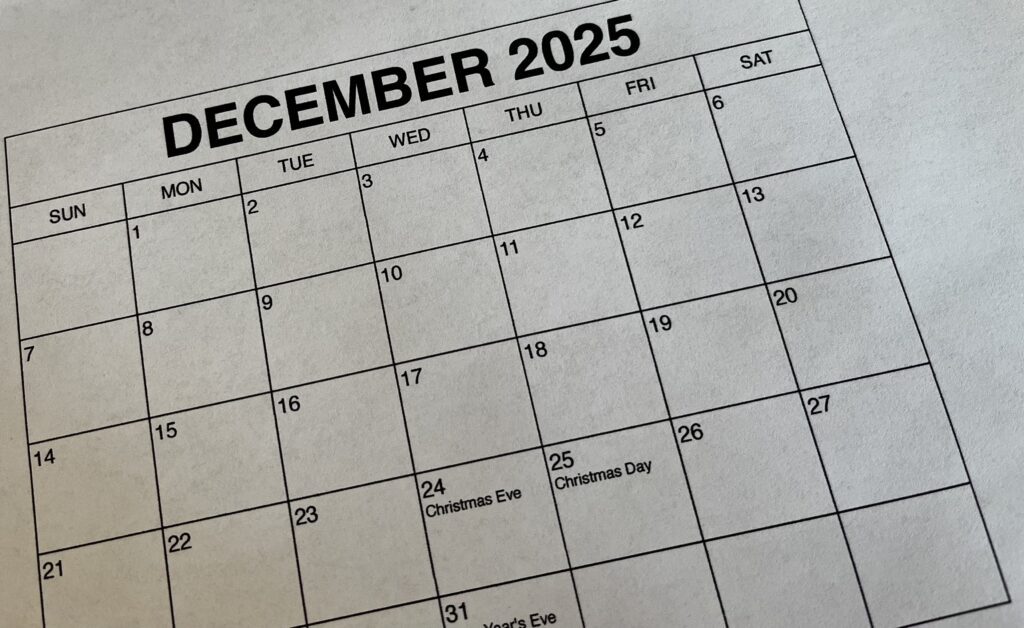
Step Four: Plan. Now I get down to specifics. I print out a blank calendar for November and December. First, I fill in medical appointments and other commitments. Then, we decide on our travel dates and I fill that in. Now I take my brain dump list from Step One and start penciling things in. If there are multiple steps to an item, I break it down and work backwards from the deadline.
For example, I usually mail gifts to a few friends. This year, I set December 10th as my deadline. But before then, I have to complete multiple tasks: choose and purchase gifts, wrap gifts, pack boxes, create mailing labels, and have my husband drop the packages at the post office. Working backwards from December 10th, I wanted to pack the boxes by December 7th, which meant wrapping the gifts by December 4th, which meant ordering by November 21st. I pencil (and pencil is key!) all the tasks into the calendar, working around appointments and commitments.
Part of this scheduling exercise is scheduling rest. I don’t have the option to look at a blank calendar and cram something into every space. I have to spread out the tasks, not tackling too much in a day and leaving space for rest. Inevitably, there isn’t room for everything. Now I apply the priorities I identified in Step Two. It’s more important for me to be relaxed and well-rested at the holidays, rather than bake all the things or invite friends over. I don’t feel as bad saying no (to myself or others) when the choice is driven by my priorities.
Step Five: Pivot and Adjust. Nothing ever goes to plan, that’s just the truth. I always have to adjust based on circumstances. In 2023, I was diagnosed with breast cancer and had surgery the day before Thanksgiving. I crossed almost everything off my list to save energy for the trip to my family for Christmas. Two days after we arrived, a family member tested positive for COVID, so we packed up and headed home (and avoided getting sick). I wasn’t so lucky last year because I got COVID in October and lost more than a month. Many things didn’t make the to do list, and most of what made it on was swiftly dropped anyway.
It took me a long time to learn that focusing on my priorities, not expectations, would make my holidays healthier and happier. If I don’t send holiday cards or bake the peppermint cookies my husband loves, that’s ok. No one’s holiday is ruined, including mine. I do what I can, and whatever that looks like from year to year is good enough.
Your post was so incredibly inspiring to me. I have just started to work like this after years with ME and, without any awareness, Autism and ADHD which are both energy sapping demons. I finally got to crisis point until I found a fantastic therapist. I still struggle with non awareness of pushing on born from trying to fit into a neuro typical world and dysfunctional upbringing. I now, as you highlighted have begun to set better boundaries and priorities.
Thank you so much for sharing your experiences it has re-enforced my commitment to carrying on.
I’m so glad this was affirming for you, Frankie!
I’ve found that USPS’s Click-N-Ship is extremely helpful. I print the labels, stick them on, and the letter carrier picks them up. Saves trips to the PO.
Our post office became unreliable about pickup during the pandemic because of staffing issues, and there have been thefts from local mailboxes! So husband gets saddled with the errand. *eyeroll*
Yeah, I get it. I can do it because my recliner looks out onto my porch and I’m there pretty much all day.
Pingback: Getting Through the Holidays with ME – The ME Global Chronicle